
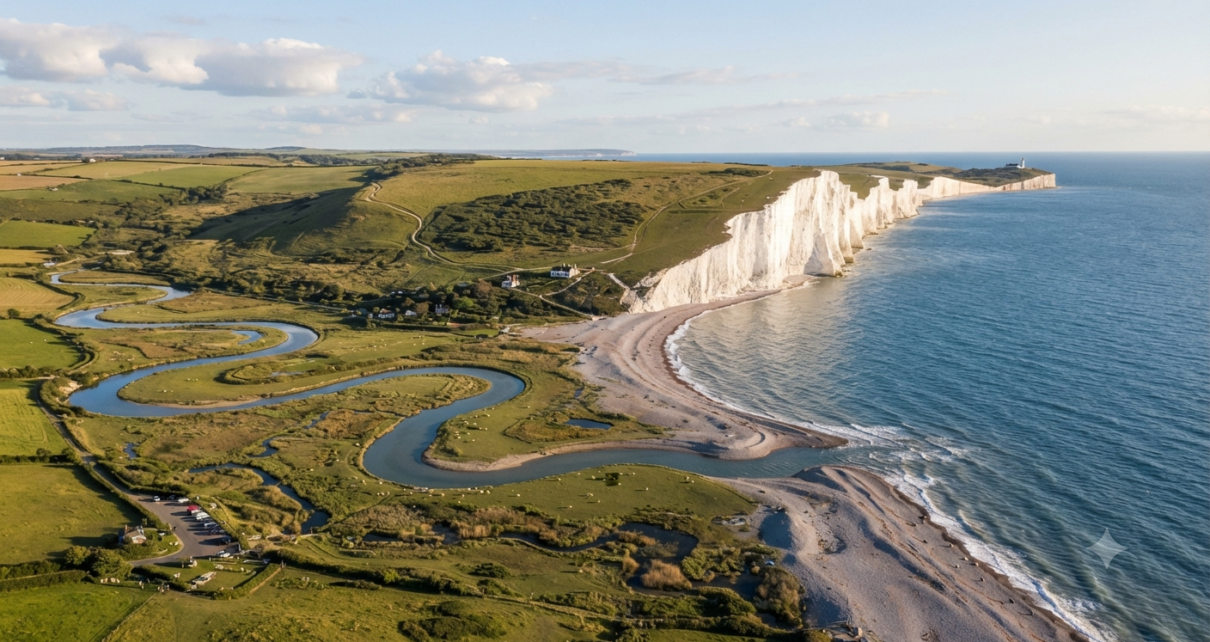
Una cadena de acantilados de un blanco inmaculado se eleva frente al canal de la Mancha. El viento, el mar y sus impresionantes vistas convierten este paraje en un enclave único que ha inspirado a numerosos artistas.
On the south coast of England, the White Cliffs of Dover are well-known as the scene of historic battles and events. If you travel a little further to the west, you will find Seven Sisters. These majestic chalk cliffs may not be so famous, but you may know them better than you think. The area has often featured in movies and series like Atonement and Anatomy of a Scandal.
Part of the South Downs National Park, Seven Sisters extends from the mouth of the River Cuckmere to Beachy Head, near Eastbourne. It comprises 280 hectares of chalk cliffs and open chalk grassland, but how do the Sisters compare to the White Cliffs of Dover? Speak Up spoke to Blue Badge Guide Maria Morote to find out.
Maria Morote (English accent): They are actually different, not only in location, but also in landscape and appearance. So, for example, the Seven Sisters, they’re like a series of very smooth, rolling, chalk hills, and they rise and fall to the sea. They’re mostly natural and undeveloped. They’ve got grassy tops, and they’ve got these deep valleys which we call the ‘coombes’. Their faces are a bit brighter, their white faces, whereas the white cliffs of Dover, they’re a tiny bit taller, they’re more continuous, they are more linear, but they appear less white, and that’s mainly due to vegetation and stabilisation. And also the Seven Sisters, it’s largely protected and is minimally built upon.
Cretaceous Park
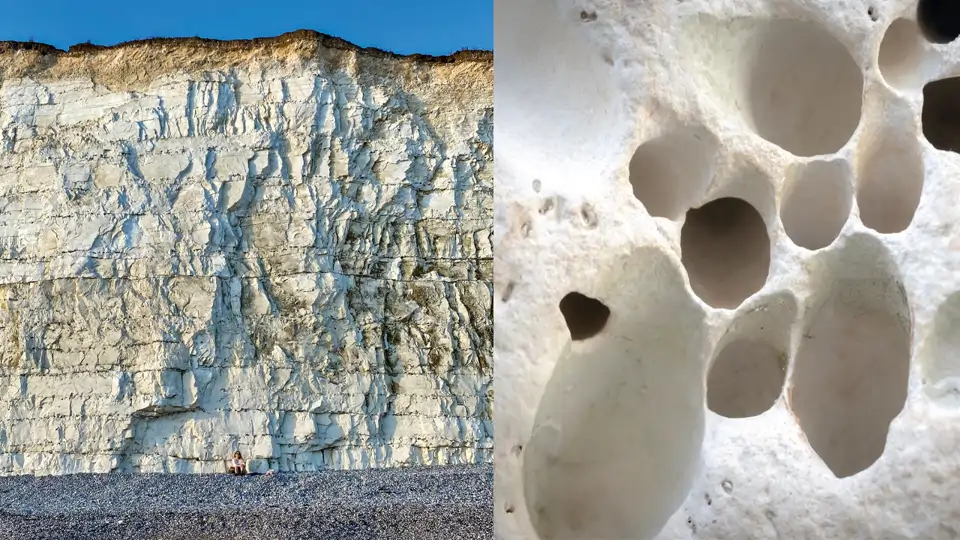
Seven Sisters was formed between sixty and 130 million years ago. Geological activity shaped the entire coastline, to produce the stunning white cliffs we see today.
Maria Morote: We’re talking about the late Cretaceous period. So that’s at least for the chalk itself. And how that chalk was created, it was basically an area that was covered by a very warm and very shallow sea. Now, these tiny microscopic, tiny marine organisms, which are called the coccolithophores, they died and the calcium-rich shells, they settled on the seabed. So over millions of years, these layers compacted into chalk with tiny bands of flint. That’s how they formed.
Seven or Eight?
While there is no mythology behind the name Seven Sisters, the cliffs each have a name of their own. From west to east, they are called Haven Brow, Short Brow, Rough Brow, Brass Point, Flagstaff Point, Went Hill Brow, and Baily’s Hill. Coastal erosion often creates an eighth sister, Flat Hill, as the landscape continuously changes.
Maria Morote: It’s made of chalk, so it’s a very soft sort of rock, and it erodes quite easily. So they’re constantly exposed to wind, rain, frost, waves, and then, of course, the sea level, it rises and there’s a storm suddenly and that surges the increase of the wave attack at the base of the cliffs. So that’s one of the reasons why they change. But also gravity, because gravity, what it does, it causes periodic cliff collapses and landslides. So that changes again the shape of these Seven Sisters. Rainwater as well, it seeps into the cracks and it weakens the chalk. When it freezes and then it thaws, that action in winter, it expands the cracks. So yeah, those are basically the main reasons why it changes. So what happens then is that the coastline slowly moves inland over time. So each of the Sisters changes its height and shape and the number of visible peaks can vary.

Lista de vocabulario inglés B1 para aprobar un examen oficial
Inspiration for Artists
Today, Seven Sisters is an area of natural beauty, with very few buildings or roads. This is largely thanks to author Rudyard Kipling. A hundred years ago, he supported a successful campaign to buy the land and protect it from urban development. Like many authors and artists, he was inspired by the area’s beauty and even praised it in his poem Sussex. Maria Morote tells us more.
Maria Morote: Turner and Constable, probably the two most famous English painters, although they never painted the Seven Sisters, that whole landscape would really inspire them. In both of their paintings we can see a lot of those type of landscapes appear. And writers in the 19th century… poets that have used this area of England to get inspiration, like they did in the Lake District.
Dramatic Backdrop
In more recent times, Seven Sisters has often appeared on the big screen, offering breathtaking backdrops for a wide range of films, from period dramas to fantasy adventures.
Maria Morote: They actually film the Seven Sisters when they want to film Dover at times. Because Dover is such a busy port, filming isn’t always very handy. And because this is so unspoilt, so they use it quite a bit. It appears in quite a number of films, actually. In Harry Potter, for example, in The Goblet of Fire, when the Quidditch World Cup is going on. And Robin Hood: the Prince of Thieves, when Robin Hood returns to England, that’s the backdrop. We also have Chitty Chitty Bang Bang… the flying car scene, which is iconic, that was filmed there, as well. Oh, Wicked! I mean, so quite recently, actually, when they enter Shiz University, that bit, that’s also filmed there.
Planning the Perfect Visit
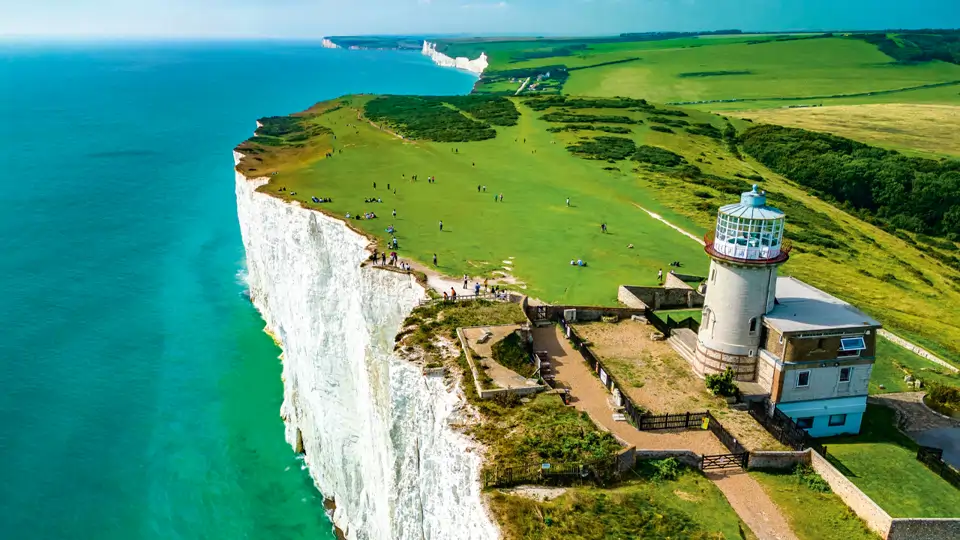
Seven Sisters can be visited year-round. The coastal trail is between 14 to 21km and takes several hours to complete. It is not an easy hike, so it is important to be prepared. The visitor centre rents out scooters to those who need one. Walking conditions are perfect in summer, but it can get very busy. On the other hand, winter days are short. We asked Maria Morote to share her favourite times of the year in Seven Sisters.
Maria Morote: It’s always beautiful, but I would say if you were to choose three months of the year when it’s beautiful to visit, that would be May, June, and September. May and June, obviously, because of the wildflowers, they’re in bloom, and it’s just amazing. And the temperatures are quite nice and the days are quite long. It’s not as crowded as in the summer and the walking conditions are just amazing. However, September, I love September because it’s that golden light. It’s so ideal, if you like photography. You know, photography in that part is one of the main reasons to visit, really. It’s just beautiful, you’ve got that golden light, as I said. And also, the sea is generally a bit calmer and there’s going to be less people walking. So it’s going to be less busy. In the summer, it’s nice because it’s warm and the views are very clear. So that’s good. It’s very good for the coastal walk. If you want to do coastal walks, then the summer is probably the best. And in the winter, I mean, what I like about the winter is when the dramatic skies and the powerful sea, it’s very atmospheric, but it can be cold, it can be windy, it can be a bit muddy. But still, you know, if you’re prepared, then that’s fine. But then you have to think about the days being shorter as well, because the whole walk is about 13 miles [21km], approximately, if you want to do the proper walk, in which case you are limited, because it would take you, depending on how fast you walk, up to six, eight hours.
www.sevensisters.org.uk