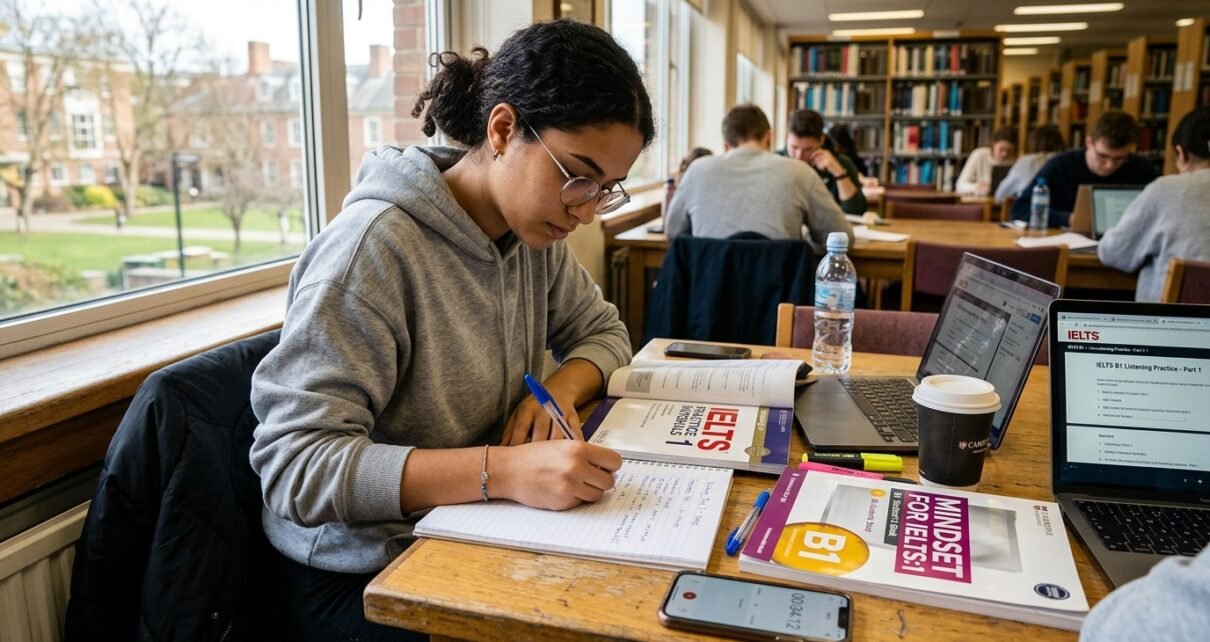
Si eres estudiante de inglés y estás pensando sacarte un título oficial intermedio, no puedes perderte este artículo con una lista de vocabulario inglés B1. En primer lugar, has de tener en cuenta que el nivel B1 es un nivel intermedio con reconocimiento en el mercado laboral, ya que avala cierta autonomía y fluidez media de la persona en diferentes ámbitos comunicativos sencillos, cotidianos o familiares.
Los exámenes oficiales constan de cuatro partes: comprensión oral y escrita (listening y reading), expresión oral y escrita (speaking y writing). El estudio y la preparación será diferente para cada una de estas partes. Sin embargo, la adquisición y dominio del vocabulario es vital y resulta fundamental para aprobar con éxito cada una de ellas. Bien es cierto que los exámenes cambian y no encontraremos dos exámenes iguales. No obstante las temáticas se repiten y la preparación a través de la práctica realizando pruebas de exámenes anteriores es una ayuda excelente. Veamos a continuación la lista de vocabulario en inglés B1 dividida en categorías: sustantivos, verbos, phrasal verbs, adjetivos y conectores.
Si el objetivo es mejorar el nivel de inglés con una planificación más completa, formación en idiomas online;permite conectar vocabulario, preparación de exámenes y competencias lingüísticas útiles para el ámbito académico y profesional.
Aprende a conjugar estos verbos
| Verbo | Significado | Ejemplo B1 |
|---|---|---|
| Accept | Aceptar | I accepted the invitation. |
| Borrow | Tomar prestado | Can I borrow your pen? |
| Lend | Prestar | She lent me her notes. |
| Remind | Recordar algo a alguien | Please remind me to call Anna. |
| Suggest | Sugerir | He suggested visiting the museum. |
| Manage | Conseguir / gestionar | I managed to finish on time. |
| Seem | Parecer | The exam seemed easy at first. |
| Wish | Desear | I wish you good luck. |
Memoriza estos Phrasal verbs
Los llamados phrasal verbs son construcciones en inglés formadas por un verbo y una preposición que, al aparecer juntos, tienen un nuevo significado, dejando de lado la primera acepción que tienen estas palabras por separado. Veremos algunos algunos ejemplos con sinónimos en inglés y su significado en español, ya que es una parte de vocabulario en inglés intermedio que debes aprender desde ya:
| Phrasal verb | Traducción | Ejemplo |
|---|---|---|
| be based on | basarse en | The story is based on real events. |
| break up | romper / separarse | They broke up last year. |
| bring up | criar / sacar un tema | She was brought up in London. |
| carry on | continuar | Carry on with your work, please. |
| come across | encontrarse con algo por casualidad | I came across an old photo. |
| come back | volver | When are you coming back? |
| come out | salir / publicarse | Her new book comes out next month. |
| deal with | lidiar con / tratar | I can deal with this problem. |
| depend on | depender de | It depends on the weather. |
| dress up | vestirse elegante / disfrazarse | We dressed up for the party. |
| end up | acabar / terminar | We ended up at the cinema. |
| fill in | rellenar / completar | Please fill in this form. |
| find out | descubrir / averiguar | I found out the answer. |
| fit in | encajar / adaptarse | He is trying to fit in at school. |
| get along with | llevarse bien con | I get along with my classmates. |
| get on | subirse a un transporte | We got on the bus at eight. |
| get off | bajarse de un transporte | Get off at the next stop. |
| get together | reunirse / juntarse | We get together every Friday. |
| get rid of | deshacerse de / librarse de | I need to get rid of these old clothes. |
| give up | rendirse / dejar de hacer algo | Don’t give up now! |
| go on | continuar / seguir | Please go on with the story. |
| go back | regresar / volver | I want to go back home. |
| grow up | crecer | He grew up in a small village. |
| hold on | esperar | Hold on a minute, please. |
| hurry up | darse prisa | Hurry up! We are late. |
| keep on | seguir / continuar | Keep on practising English. |
| let down | decepcionar | I don’t want to let you down. |
| look back | mirar atrás / recordar | When I look back, I feel proud. |
| look forward to | esperar algo con ganas | I’m looking forward to the trip. |
| look out | tener cuidado / mirar hacia fuera | Look out! There is a car. |
| pick up | recoger | Can you pick me up at six? |
| put on | ponerse ropa | Put on your coat. |
| put off | aplazar | The meeting was put off. |
| run out of | quedarse sin algo | We have run out of milk. |
| split up | separarse / dividir | The class split up into groups. |
| turn on | encender | Turn on the TV, please. |
| turn off | apagar | Turn off the lights. |
| turn out | resultar | It turned out to be easy. |
| watch out | tener cuidado | Watch out! The floor is wet. |
| Consejo de estudioNo aprendas un phrasal verb aislado. Aprende una frase completa. Por ejemplo, en lugar de memorizar solo give up = dejar, recuerda: Don’t give up learning English. Así tendrás una estructura lista para usar en el speaking o el writing. |
Adjetivos que debes aprender para el writing del B1
La siguiente lista de objetivos está formada por palabras básicas en inglés que debes aprender para la parte de writing del examen de cambridge B1, por ejemplo. Es importante que tomes tus propios apuntes y te guardes la información que necesites. ¡Tienes que conseguir ese título!
| Adjetivo | Traducción | Ejemplo |
|---|---|---|
| alone | solo/a | I was alone at home yesterday. |
| current | actual | My current job is very interesting. |
| early | temprano/a | We arrived early at the station. |
| famous | famoso/a | It is a famous museum in London. |
| far | lejano/a / lejos | The hotel is far from the beach. |
| favourite | favorito/a | My favourite subject is English. |
| healthy | saludable | I try to eat healthy food every day. |
| heavy | pesado/a | My bag was very heavy. |
| interested | interesado/a | I am interested in learning languages. |
| narrow | estrecho/a | The street was narrow and quiet. |
| soon | pronto | I hope to see you soon. |
| strong | fuerte | She has a strong opinion about this topic. |
| useful | útil | This website is very useful for students. |
| amazing | impresionante | The view from the mountain was amazing. |
| amazed | impresionado/a | I was amazed by the concert. |
| bored | aburrido/a | I was bored during the film. |
| boring | aburrido/a, que aburre | The film was boring. |
Diferencia entre adjetivos terminados en -ed e -ing
Los adjetivos terminados en -ed describen cómo se siente una persona. Los terminados en -ing describen qué provoca esa sensación.
- I was bored because the film was boring. → Yo estaba aburrido porque la película era aburrida.
- He was amazed by the amazing view. → Estaba impresionado por las vistas impresionantes.
- She was interested in the interesting topic. → Ella estaba interesada en el tema interesante.
Adverbios más utilizados en inglés
Los adverbios en inglés son palabras que nos ayudan a dar más información sobre una acción, una situación o una idea. Para quienes se están preparando para el nivel B1 de inglés, son especialmente útiles para mejorar el writing y el speaking, ya que permiten explicar cómo, cuándo, dónde o con qué frecuencia ocurre algo.
Por ejemplo, no es lo mismo escribir I finished my homework que I finished my homework carefully. En la segunda frase, el adverbio carefully añade precisión y demuestra un mayor dominio del vocabulario. Por eso, aprender a usar adverbios frecuentes puede ayudarte a construir frases más completas, naturales y mejor valoradas en un examen oficial.
Recuerda:
Muchos adverbios de modo se forman añadiendo -ly al adjetivo: careful → carefully, general → generally. Sin embargo, otros adverbios son irregulares o no cambian de forma, como here, there, now o fast.
| Adverbio | Traducción | Ejemplo B1 |
|---|---|---|
| fortunately | afortunadamente | Fortunately, we arrived on time. |
| unfortunately | desafortunadamente | Unfortunately, I lost my ticket. |
| approximately | aproximadamente | The journey takes approximately two hours. |
| carefully | cuidadosamente | Read the instructions carefully. |
| generally | generalmente | Generally, I study in the evening. |
| mainly | principalmente | I use English mainly at work. |
| mostly | mayormente / sobre todo | I mostly watch films in English. |
| particularly | especialmente / particularmente | I particularly enjoyed the last chapter. |
| really | realmente / muy | The exam was really difficult. |
| specifically | específicamente | This exercise is specifically for B1 students. |
| totally | totalmente | I totally agree with you. |
| here | aquí | You can sit here. |
| there | allí | I left my bag there. |
| now | ahora | I am studying English now. |
| just | solo / justo / acabar de | I just finished my homework. |
Ejemplos de adverbios en frases para el B1
- Unfortunately, I could not go to the party because I was ill.
- I usually write my answers carefully before giving them to the teacher.
- This app is really useful for learning vocabulary.
- I totally agree with your opinion.
- My school is approximately ten minutes from my house.
Conectores del inglés que debes conocer para tu examen del B1 en inglés
Los conectores (o linkers) son una categoría importantísima en todos los idiomas. Pues además de aportar cohesión y coherencia a nuestro texto, ordenarlo de manera lógica, cronológica, nos ayudan a expresarnos mejor. Además, un buen uso de los conectores se valora muy positivamente en los exámenes oficiales y es un tema que siempre cae en los exámenes.
| Conector | Uso | Traducción | Ejemplo |
|---|---|---|---|
| and | Añadir información | y | I like reading and watching films. |
| also | Añadir otra idea | también | I also enjoy listening to music. |
| besides | Añadir un argumento | además | It is cheap. Besides, it is near my house. |
| because | Explicar causa | porque | I stayed at home because I was tired. |
| so | Expresar consecuencia | así que / por eso | It was late, so I went home. |
| but | Contrastar ideas | pero | The hotel was nice, but it was expensive. |
| although | Contraste más elaborado | aunque | Although it was raining, we went out. |
| however | Contrastar dos frases | sin embargo | I wanted to travel. However, I had to work. |
| despite | Contraste con sustantivo o gerundio | a pesar de | Despite the cold weather, we enjoyed the trip. |
| in spite of | Contraste con sustantivo o gerundio | a pesar de | In spite of being tired, I finished the project. |
| first | Ordenar ideas | primero | First, you need to read the question. |
| then | Continuar una secuencia | después / luego | Then, write your answer clearly. |
| finally | Cerrar una secuencia | finalmente | Finally, check your spelling. |
| in conclusion | Cerrar una opinión | en conclusión | In conclusion, learning English is useful. |
Truco para el writing:
Para un texto B1, combina conectores sencillos y claros: usa because para explicar causas, but o however para contrastar ideas y first, then y finally para ordenar el texto.
Errores comunes al usar conectores en inglés
- No uses muchos conectores en una misma frase. Puede hacer que el texto suene artificial.
- No confundas although y however. Although introduce una idea dentro de la misma frase; however suele conectar dos frases diferentes.
- Recuerda la estructura de despite e in spite of. Después de estos conectores se usa un sustantivo o un verbo acabado en -ing: Despite being tired…
- No traduzcas siempre literalmente desde el español. Algunos conectores tienen usos distintos según la estructura de la frase.
Sustantivos que caen sí o sí en el examen del B1 en inglés
Esta es una categoría bastante amplia. No obstante, y como hemos mencionado anteriormente, suelen ser temáticas relacionadas con el tiempo libre, los viajes, las vacaciones, el deporte, la comida – y normalmente tipos de vida saludable-, la ropa, los medios de transporte… Esta lista de esta categoría de vocabulario inglés intermedio podría ser muy extensa, ya que los temas son amplios. En cualquier caso, dejaremos algunos relativos a dichas temáticas a modo de ejemplo:
| Sustantivo | Traducción | Ejemplo |
|---|---|---|
| agreement | acuerdo | We finally reached an agreement. |
| baggage / luggage | equipaje | My luggage is very heavy. |
| beach | playa | We spent the afternoon at the beach. |
| dessert | postre | I had fruit for dessert. |
| earth | tierra / planeta Tierra | We must protect the Earth. |
| health | salud | Sport is good for your health. |
| holiday | vacaciones | I went to Italy on holiday. |
| job | trabajo / empleo | She has a new job in London. |
| lake | lago | There is a beautiful lake near my town. |
| mountain | montaña | We climbed a mountain last weekend. |
| public transport | transporte público | Public transport is cheaper than driving. |
| river | río | The river is very long. |
| sea | mar | I love swimming in the sea. |
| village | pueblo | My grandparents live in a small village. |
| wealth | riqueza | Health is more important than wealth. |
| weather | tiempo / clima | The weather was terrible yesterday. |
Ojo con este error típico:
Dessert significa “postre”, mientras que desert significa “desierto”. Una sola s cambia por completo el significado.
False friends en inglés B1: palabras que parecen una cosa, pero significan otra
Los false friends o falsos amigos en inglés son palabras que se parecen mucho a otras en español, pero tienen un significado diferente. Son especialmente importantes en el nivel B1 porque pueden provocar errores en preguntas de comprensión, traducción mental o redacción.
La clave está en no fiarse solo de la apariencia de la palabra. Por ejemplo, actually no significa “actualmente”, sino “en realidad”. Para decir “actualmente”, deberías usar currently.
Tabla de false friends frecuentes en inglés B1
| Palabra en inglés | Significa | No significa | Para decir eso usa… |
|---|---|---|---|
| actually | en realidad | actualmente | currently |
| argument | discusión | argumento de una historia | plot |
| assist | ayudar | asistir a un evento | attend |
| commodity | producto / mercancía | comodidad | comfort |
| compromise | acuerdo mutuo | compromiso personal | commitment |
| contest | concurso | contestar | answer |
| diversion | desviación | diversión | fun |
| eventually | finalmente / al final | eventualmente | occasionally |
| introduce | presentar a alguien | introducir algo dentro | insert |
| library | biblioteca | librería | bookshop |
| notice | aviso / nota | noticia | news |
| sensible | sensato/a | sensible | sensitive |
| sensitive | sensible | sensitivo | sensitive / perceptive |
| realise | darse cuenta | realizar / hacer | make / do |
| record | grabar / registro | recordar | remember |
| soap | jabón | sopa | soup |
Vocabulario en inglés B1 por temas
Una forma práctica de ampliar tu vocabulario B1 es estudiarlo por bloques temáticos. Así podrás preparar respuestas más completas para el speaking y textos más naturales para el writing. A continuación encontrarás cinco temas habituales en exámenes de nivel intermedio.
| Cómo usar esta sección:Elige un tema.Aprende 8-10 palabras clave.Escribe 3 frases usando ese vocabulario.Practica una respuesta oral de 30 segundos. |
Familia y amigos
| Palabra | Traducción | Ejemplo |
|---|---|---|
| siblings | hermanos/as | I have two siblings. |
| relatives | parientes | My relatives live near me. |
| cousin | primo/a | My cousin is studying English too. |
| supportive | que apoya / comprensivo | My family is very supportive. |
Frase útil para el speaking: I get on well with my family because they are supportive.
Comida y cocina
| Palabra | Traducción | Ejemplo |
|---|---|---|
| breakfast | desayuno | I usually have toast for breakfast. |
| recipe | receta | This recipe is easy to follow. |
| ingredients | ingredientes | We need fresh ingredients. |
| spicy | picante | I do not like very spicy food. |
Frase útil para el writing: My favourite meal is dinner because I can cook with my family.
Ocio y tiempo libre
| Palabra | Traducción | Ejemplo |
|---|---|---|
| hobby | afición | My favourite hobby is reading. |
| sightseeing | hacer turismo | We went sightseeing in Madrid. |
| hiking | senderismo | I often go hiking at weekends. |
| photography | fotografía | Photography helps me relax. |
Frase útil para el speaking: In my free time, I enjoy hiking because it helps me relax.
Trabajo y trayectoria profesional
| Palabra | Traducción | Ejemplo |
|---|---|---|
| career | carrera profesional | I want to have a career in marketing. |
| colleague | compañero/a de trabajo | My colleague speaks English very well. |
| interview | entrevista | I have a job interview tomorrow. |
| skills | habilidades | Communication skills are very important. |
Frase útil para el writing: I would like to improve my English because it is useful for my career.
Arte y música
+
| Palabra | Traducción | Ejemplo |
|---|---|---|
| concert | concierto | The concert was amazing. |
| lyrics | letra de una canción | I like the lyrics of this song. |
| exhibition | exposición | We visited an art exhibition. |
| creative | creativo/a | She is a very creative person. |
Frase útil para el speaking: I enjoy going to concerts because music makes me feel happy.