
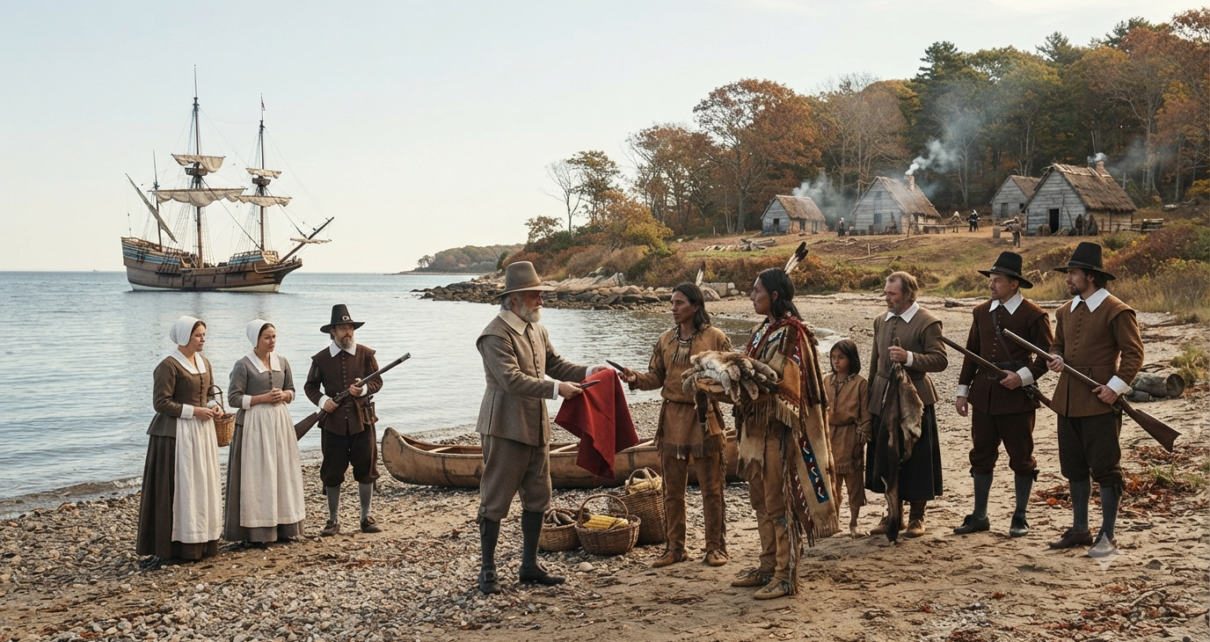
¿Fundadores de la nación americana o simples supervivientes? El mito de los Padres Peregrinos choca, desde varios puntos de vista, con la realidad de los hechos.
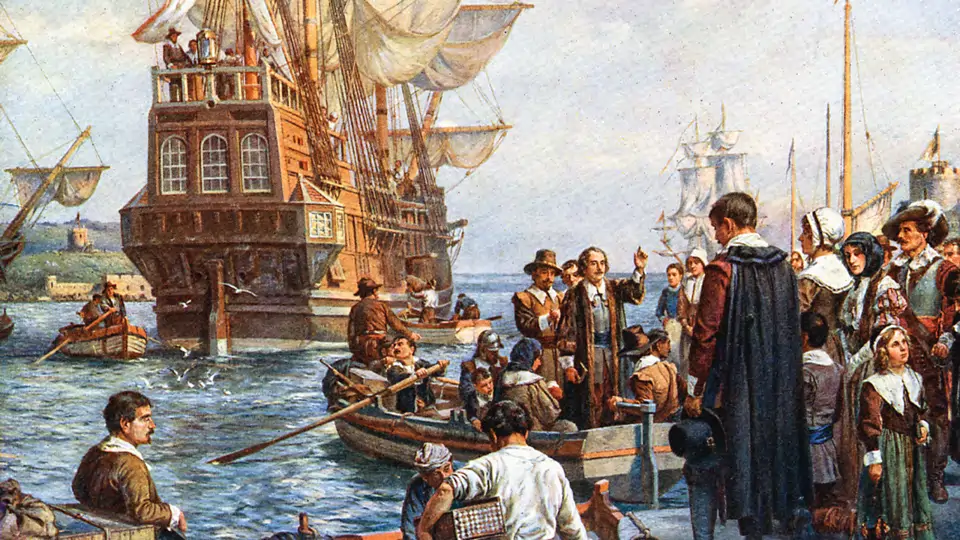
Contrary to common belief, the story of the Mayflower and its contribution to the founding of the United States is not one of persevering pilgrims with inclusive moral values, but of a chaotic and guarded group who survived against the odds. Initially two ships had left England, but only one made the journey. As the crowded Mayflower neared the American coast in early November 1620, the religious Separatists aboard it began to worry. They had left England without a charter from the king authorising the colony. So they insisted on a document to give their new society a legal structure. They decided to create a compact, a document that would establish a future government. Forty-one men — 90 per cent — signed the document, but women were excluded. Many people consider that this document — known as the Mayflower Compact — is the foundation of American democracy, the first document to establish self-government in the New World. However, representative government had actually existed since 1619, when the Jamestown settlement in Virginia, established in 1607, created an elected assembly. On the democratic nature of the Mayflower Compact, Kathleen Burk, Professor Emerita of modern and contemporary history at University College, London, is clear.
Kathleen Burk (American accent): Americans, for many reasons, see this as the origins of their democracy. If you just look at the documents, that’s not so. They did not set up a democracy. They set up an oligarchy, which is rule by the few, not rule by the many.
Deadly Beginnings
Off the coast of modern-day Cape Cod, Massachusetts, the settlers decided to land at a location named Plymouth. Winter was coming and they had little food. They made temporary shelters on the beach, but most stayed on the boat. Over the next few months, forty-four died, almost half the colonists, from dysentery, pneumonia, malnutrition and scurvy. The ‘ship of hope’ was now a ‘ship of death’, in the words of one historian.
Vital Indian Help
Then, in the spring of 1621, members of the Wampanoag tribe, the local Native Americans, decided to help. Many members had died from the bubonic plague four years earlier, brought by French settlers, and they needed help against other local tribes. The Wampanoag reached an agreement with the Separatists’ leader, William Bradford. They would show the settlers how to cultivate the land, and the settlers would support them against the other tribes.
Origins of Thanksgiving
After their first successful harvest, the settlers organised a celebration. The Wampanoag arrived to share their food with the settlers. Over time, this moment came to be a defining episode — real or mythologised — in American history, and the source of the country’s most significant celebration: Thanksgiving. The colonists, however, did not have a high opinion of the Native Americans. William Bradford was typical, according to Professor Burk.
Kathleen Burk: The general feeling of Bradford as well as many other, most other Westerners, was that these Native Americans were little better than animals. This is because, as John Locke later wrote in his laws, that to be civilised, a people had to have an organised government and a system of laws. And they couldn’t just wander around. They had to have a settled place. And therefore, he said, God mandated that this territory be farmed and settled by those who had [a] settled place, laws, knew what to do, that otherwise, that was why the English deserved the land, and the Native Americans did not.
Success or Failure
Historians disagree over how to consider the Plymouth colony. The colony did not die, but numbers grew only very slowly. The Separatists, being Separatists, did not want to join with other colonists who soon started arriving from England. These colonists, mostly Puritans, began to arrive in their thousands from 1630 onwards, settling to the north of Plymouth, in Boston. In time, members of the original Plymouth colony left for other settlements. Is this a success story? And yet, the Mayflower and Plymouth are both iconic names in American history and culture. They are fundamental to the story of the birth of the country. How did this happen?
A Young Country
According to some historians, we have to go back two hundred years. The United States of America was a young country. In New England, politicians, pastors, poets and artists started to romanticise the historical events, turning it into American’s foundation story… or myth. In the process, they ignored earlier settlements, such as Jamestown in 1585 and the lost colony of Roanoke in 1587. The new phrase ‘Pilgrim Fathers’, to describe the Plymouth colonists, helped capture the public’s imagination. In 1920, on the 300th anniversary, a political element was added: politicians and historians declared that the Mayflower Compact was actually the precursor to the Declaration of Independence in 1776 and “the birth of constitutional liberty.”
Plymouth’s Dominance
But why did Plymouth dominate the story of America’s birth? There are several possible reasons. Jamestown was the first permanent English settlement in North America, and it saw the first representative government in 1619. But 1619 also saw the arrival of the first black slaves in an English settlement, in Jamestown. The settlement was just men and boys, established for economic and not religious reasons, and had a reputation for drunkenness. There is evidence that the starving settlers even resorted to cannibalism! Perhaps it was not a good model? Another important reason is the strong print culture of the Puritan colonies established after Plymouth as the 17th century progressed. These settlers, many of them Cambridge University academics, understood the power of the written, published word. According to Dr. Kathryn Gray, Associate Professor in early American literature at the University of Plymouth, they wanted to tell their story and they never stopped writing.
Kathryn Gray (Scottish accent): In the 19th century, when scholars, when thinkers, when politicians come back to their colonial heritage, there is a massive amount of information from New England because they wrote literally everything down and published as much as they possibly could. And so this huge amount of material comes to dominate, I think, and they’ve already written the histories — they’ve been writing the histories from day one.
THE AMERICAN DREAM
There is another reason for Plymouth’s dominant place in America’s history, one that goes to the heart of the American Dream. The passengers on the Mayflower were immigrants, pilgrims on a pilgrimage to a new land. The immigrants of later years, of later centuries, could identify with this idea.
Kathleen Burk: These pilgrims were going to build a new city on the hill, so that they could worship as they wished. So [the] Americans’ world is a land of immigrants and a land of colonists, and therefore they saw this as their origins. Mayflower Compact, misinterpreted as it was, was important because it’s seen as the first milestone on the way to the Declaration of Independence and the Constitution. And essentially every country that does not just grow up out of the ancient world almost needs a start, and the Americans see the Plymouth colony as the start of their great nation.
GLOSSARY
belief: creencia
founding: fundación
persevering: perseverantes
against the odds: contra las adversidades
crowded: atestado
to near: acercarse
charter: carta estatutaria
compact: pacto, convenio
to sign: firmar
to set up: establecer
rule: gobierno
off the coast: en la costa
to land: desembarcar
shelters: refugios
scurvy: escorbuto
to reach: alcanzar
harvest: cosecha
over time: con el tiempo
people: pueblo
to wander around: vagar por ahí
therefore: por tanto
to farm: cultivar
otherwise: de otro modo
to deserve: merecer
in their thousands: a millares
slaves: esclavos
drunkenness: ebriedad
to starve: morir de hambre
print culture: cultura de la letra impresa
academics: profesores universitarios
huge amount: gran cantidad
to worship: adorar
as they wished: come quisieran
milestone: hito