A lost dog
Instructions: Do the preparation exercise first. Then do the other exercises.
Preparation
HideImage description
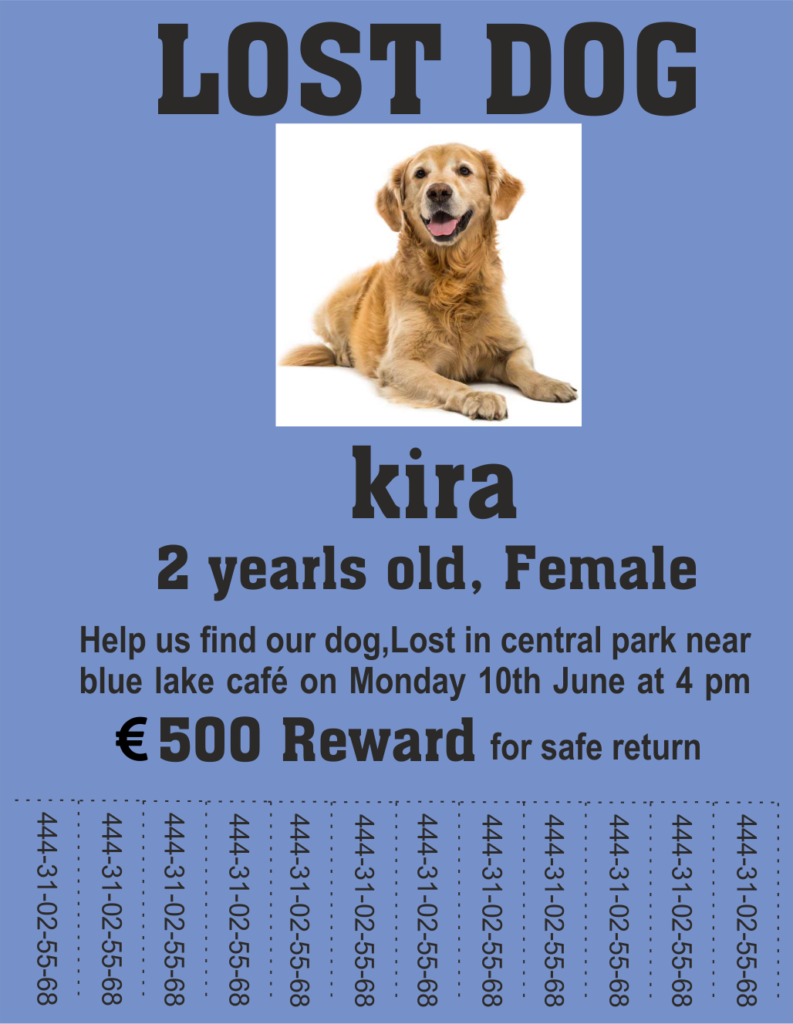
See moreHere is a poster for a lost dog.
Lost dog
kira
2 years old, female
Help us find our dog. Lost in Central Park near Blue Lake Café on Monday 10th June at 4 p.m.
€500 reward for safe return
444 31 02 55 68
Task 2 Check your understanding: true or false
See more
HideCheck your understanding: gap fill
See more
ShowCheck your understanding: error correction
See more
ORTOGRAFÍA
| 1. Cuando un verbo termina en y, precedida por una consonante, se cambia la y por i y se le agrega |
| es para formar la tercera persona singular del presente. |
| Ejemplos: he studies pero: he plays (precedido por una vocal). |
| 2. Cuando un verbo termina en sonido de s, sh, ch, x, se le agrega es para formar la tercera persona |
| singular. Ejemplos: kiss (besar), kisses; wash, washes; reach, reaches; fix, fixes. |
| 3: Cuando un verbo termina en y, precedida por una consonante, se cambia por i y se le agrega ed |
| para formar el pasado. Ejemplos: he hurried; pero: he played (precedido por una vocal). |
| 4. Los sustantivos terminados en y, precedida por una consonante, forman su plural cambiando la y |
| por i y agregando la terminación es. Ejemplos: city, cities family, families |
| 5. Los sustantivos terminados en s, sh, ch, x, forman su plural agregando es. |
| Ejemplos: dress, dresses fox, foxes |
| 6. Los sustantivos terminados en efe forman su plural cambiando la f por v y agregando es. |
| Ejemplos: wife, wives knife, knives, loaf, loaves |
| 7. Si el verbo termina en e, se suprime ésta antes de agregar ing. |
| Ejemplos: give,giving, come, coming . |
| Verbos monosílabos que terminan en una sola consonante, precedida de una sola vocal, duplicaran |
| la consonante final antes de agregar ing. |
| Ejemplos. put, putting, stop, stopping. |
| Esta regla se aplican también a los verbos polisílabos cuando la última sílaba lleva el acento. |
| Ejemplo: begin, beginning pero: visit, visiting (lleva el acento en la primera sílaba). |
| 8. Verbos monosílabos que terminan en una sola consonante, precedidos de una sola vocal, |
| duplicarán la consonante final antes de agregar ed. |
| Ejemplos: drop, dropped; stop, stopped |
| Esta regla se aplicará también a los verbos polisílabos cuando la última sílaba lleva el acento. |
| Ejemplos: refer (referir), referred pero: visit, visited (lleva el acento en la primera sílaba). |
| Todos los verbos regulares que duplican la consonante final para formar el gerundio sufren el |
| mismo cambio en la formación del pasado. Ejemplos: drop, dropping, dropped, stop, stopping, stopped. |
Lesson twenty
Vocabulary
| 1. to break, broke – romper, rompió | 10. crow – cuervo | |||||
| 2. to try, tried – tratar, trató; | 11. pitcher – jarra | |||||
| probar, probó – (de intentar) | 12. woods – bosque | |||||
| 3. to drop, dropped – tirar, tiró; | forest bosque | |||||
| caérsele a uno, se le cayó a uno | 13. stone – piedra | |||||
| 4. to pick out, picked out – escoger, escogió | rock – roca | |||||
| 5. to pick up, picked up – alzar, alzó, | 14. way – manera; camino | |||||
| recoger, recogió | 15. idea – idea | |||||
| 6. to reach, reached – alcanzar, alcanzó; | 16. top – parte superior; cima | |||||
| llegar, llegó | 17. cream – crema | |||||
| 7. strong – fuerte | 18. sugar – azucar | |||||
| 8. short – corto, chaparro | 19. potatoes – papas | |||||
| 9. black – negro | 20. head – cabeza |
| MODISMOS |
| 1. to give up darse por vencido |
| 2. to get thirsty, hungry, sleepy, etc. darle a uno sed, hambre, sueño, etc. . |
| He got thirsty. Le dió sed. |
| 3. more than anything else más que nada, por encima de todo |
| 4. There is (are)…left. Queda(n)… |
| There’s one left. Queda uno. |
| There are three left. Quedan tres. |
| 5. to have …left quedársele a uno … |
| I have one left. Me queda uno. |
| He has three left. Le quedan a él tres. |
| 6. not…any more, not…any longer ya no |
| I don’t work here any more. Ya no trabajo aqui. |
| I don’t live in Mexico any longer. Ya no vivo en México. |
| 7. plenty (of) bastante (de sobrar) |
| I have plenty. Tengo bastante. |
| I have plenty of time. Tengo bastante tiempo. |
| (Se emplea of solo cuando sigue un sustantivo.) |
| 8. enough suficiente, bastante (de alcanzar) |
| enough time suficiente tiempo, bastante tiempo |
| tall enough bastante alto |
PREPOSICIONES
Aprenda estas preposiciones
| 1. through a través de, por | |||
| 2. across al otro lado de | |||
| 3. up to hasta | |||
| 4. on the other side of más alla de, pasando | |||
| 5. between entre | Between se usa refiriéndose a dos. | ||
| 6. among entre | Among se usa refiriéndose a más de dos. |
Haz los ejercicios del libro con tu profesor
LAS PREPOSICIONES AL FINAL DE LA ORACIÓN
Las preposiciones tales como at, to, of, for, from, with, about que se colocan al principio de las preguntas en español, se colocan en inglés al final. Estudie las siguientes oraciones:
| 1. What’s it made of? ¿De qué es? |
| 2. What are you laughing at? ¿De qué te ríes? |
| 3.Who are you going with? ¿Con quién vas? |
| 4. Where did he come from? ¿De dónde vino el? |
| 5.What are you looking for? ¿Qué busca Ud.? |
| 6. What are they looking at? ¿Qué ven? |
| 7. What did you want that for? ¿Para qué quisiste eso? |
| 8. What did he go home for? ¿Para qué fue a casa? |
| He went home to eat. (Recuérdese que no se usa la palabra for (para) antes de un infinitivo). Pero: He went home for his book. (Se puede usar for antes de un sustantivo.). |
| He went home because (porque) he was sick. |
EL EQUIVALENTE DE ¿NO ES VERDAD?
| Para traducir las preguntas ¿no es verdad?, ¿verdad?, ¿no?, ¿no es así?, con las que se pide asentimiento o confirmación, se repite el pronombre (o el pronombre correspondiente al sustantivo) y se usa el auxiliar que se emplearía para poner el verbo en negativo. |
| Si el primer verbo de la oración es afirmativo, el auxiliar en la pregunta corta estará en negativo. |
| Si el primer verbo es negativo, el auxiliar en la pregunta corta estará en afirmativo. |
| Estudie los siguientes ejemplos. |
| 1.It’s clean, isn’t it? |
| It isn’t clean, is it? |
| 2.There’s time, isn’t there? |
| There isn’t any time, is there? |
| 3.He’s eating, isn’t he? |
| He isn’t eating, is he? |
| 4.They’re going to come, aren’t they? |
| They aren’t going to come, are they? |
| 5.You were writing, weren’t you? |
| You weren’t writing, were you? |
| 6.I have to eat, don’t I? |
| I don’t have to eat, do I? |
| 7.the car works, doesn’t it? |
| the car doesn’t work, does it? |
| 8.Henry likes to teach, doesn’t he? |
| Henry doesn’t like to teach, does he? |
| 9.John’s sister went, didn’t she? |
| John’s sister didn’t go, did she? |
| 10.Your brother wanted to sleep, didn’t he? |
| Your brother didn’t want to sleep, did he? |
| 11.John can win, can’t he?. |
| John can’t win, can he? |
| 12.Mary and I could study, couldn’t we? |
| Mary and I couldn’t study, could we? |
Haz los ejercicios del libro con el profesor
LESSON NINETEEN
Vocabulary
| 1. to show, showed – mostrar, mostró, enseñar, enseñó | 13. poor – pobre | |||||
| 2. to hurry, hurried – apresurarse, se apresuró | 14. pure – puro | |||||
| 3. to kill, killed – matar, mató | 15. beautiful – hermoso, guapo | |||||
| 4. to cut, cut – cortar , cortó | 16. gold – oro, de oro | |||||
| 5. to become, became – llegar a ser, llegó a ser; | golden – de oro; dorado | |||||
| hacerse, se hizo; volverse, se volvió; ponerse, se puso | 17. goose – gansa,oca | |||||
| 6. to love, loved – amar, amó | geese – gansos, ocas | |||||
| 7. as – mientras; cuando | 18. farm – granja | |||||
| 8. while – mientras que | farmer granjero | |||||
| 9. once – una vez | 19. food – alimento, comida | |||||
| 10. again – otra vez | 20. another – otro | |||||
| 11. busy – ocupado | 21. hand – mano | |||||
| 12. rich – rico |
| MODISMOS |
| 1. to lay eggs, laid eggs poner huevos, puso huevos |
| 2. to get rich, got rich. hacerse rico, se hizo rico |
| 3. at once, inmediatamente; de una vez |
| 4. Hurry (up) Apresúrese |
| 5. I’m in a hurry. Estoy de prisa. |
| 6. scrambled eggs – huevos revueltos |
| fried eggs – huevos fritos |
| boiled eggs – huevos cocidos |
| 7. to be about – tratar de. |
| What’s the book about? ¿De qué trata el libro? |
| What’s it about? ¿De qué trata? |
| It’s about animals. Trata de animales. |
| 8. not…either – no…tampoco |
| I didn’t go either. Yo no fui tampoco, Tampoco fui yo. |
VERBOS Y PREPOSICIONES
Estudie los siguientes verbos y preposiciones.
| 1. To go out salir. |
| He went out. Él saIió |
| 2. To go out of salir de |
| He went out of the room. Salió del cuarto. |
| 3. To look out asormarse |
| He looked out. Él se asomó. |
| 4. To look out of asomarse por |
| He looked out of the window. Se asomó por la ventana. |
| 5. To take (something) out sacar (algo) |
| He took the flowers out. Sacó las flores. |
| 6. To take (something) out of sacar (algo) de |
| He took the flowers out of the vase. Sacó las flores del florero. |
| 7. Out of fuera de |
| 8. Outside afuera (de un local), fuera de |
| 9. Up arriba hacia arriba |
| 10. Down abajo hacia abajo |
Haz los ejercicios del libro con tu profesor
EVERYTHING, EVERYBODY (EVERYONE), EVERYWHERE (EVERY PLACE)
| everything todo, todas las cosas |
| everybody (everyone) todos, todo el mundo. |
| everywhere (every place) por, a, en todas partes |
| Se emplean las palabras everything, everybody (everyone), everywhere (every place) en oraciones afirmativas, negativas, interrogativas o interrogativas negativas. |
| Las palabras everybody (everyone), everything siempre llevan el verbo en singular. |
| Estudie las siguientes oraciones. |
| (afirmativo) | 1. He has everything. | Él tiene todo. |
| (afirmativo) | 2. Everybody is sick. | Todo el mundo está mal. |
| (interrogativo) | 3. Is everyone here? | ¿Están todos? |
| (interrogativo negativo) | 4. Isn’t everyone here? | ¿No están todos? |
| (negativo) | 5. He didn’t look everywhere. | No buscó por todas partes. |
| (interrogativo) | 6. Did he look everywhere? | ¿Buscó por todas partes? |
Haz los ejercicios del libro con tu profesor
SOMEWHERE (SOME PLACE), ANYWHERE (ANY PLACE), NOT … ANYWHERE (ANY PLACE), NOWHERE (NO PLACE)
| somewhere (some place) alguna parte, algún lado |
| anywhere (any place) alguna parte, algún lado |
| not … anywhere (any place) ninguna parte, ningún lado |
| nowhere (no place) ninguna parte, ningún lado |
| La regla para el empleo de las siguientes palabras es igual a la que hemos visto anteriormente. |
| Se emplea somewhere (some place) cuando el verbo y el sentido de la oración están en afirmativo. |
| Se emplea anywhere (any place) cuando la oración tiene el verbo en negativo o cuando la oración es interrogativa. Se emplea nowhere (no place) cuando el verbo está afirmativo pero el sentido de la oración es negativo. Not…anywhere (any place) equivalen a nowhere (no place); aquéllos son mucho más usuales. |
| Recuerde Ud. que el inglés no permite doble negación y fíjese en las traducciones de los ejemplos. |
| (verbo afirmativo y sentido afirmativo) 1. He went some place. Él fue a alguna parte. |
| (verbo negativo) 2. He didn’t go anywhere. No fue a ningún lado. |
| (verbo afirmativo y sentido negativo) 3. He went nowhere No fue a ningún lado. |
| (oración interrogativa) 4. Did he go anywhere? ¿Fue a alguna parte? |
| (oración interrogativa) 5. Didn’t he go anywhere? ¿No fue a ninguna (alguna) parte? |
| (verbo afirmativo y sentido afirmativo) 6.Somebody went some place Alguien fue a alguna parte. |
| (verbo afirmativo y sentido negativo) 7. Nobody went anywhere. Nadie fue a ningún lado |
Haz los ejercicios del libro con tu profesor
Comentarios recientes