High-achieving teenagers
Listen to the radio interview about high-achieving teenagers and do the exercises to practise and improve your listening skills.
Instructions
Do the preparation exercise before you listen. Then do the other exercises to check your understanding.
Preparation
See more

Transcript
See morePresenter: Next on the programme we have an interview with someone who has been writing a book about high-achieving teenagers. Welcome, Louise Hardy.
Louise: Hi, it’s lovely to be here.
Presenter: Louise, many of these teenagers who have achieved success and fame early on, have done so through using new technology, haven’t they? Through blogging or using YouTube or Twitter?
Louise: Absolutely, and the greatest example of this is Justin Bieber. As I think everyone on the planet knows, he started off by posting videos on YouTube at the age of 14 and was spotted by a talent scout who worked with the R&B singer Usher. After that he very rapidly became a worldwide sensation.
Presenter: I heard that last year he was said to be more influential than Obama!
Louise: (laughs) Yes, that was because he is number one on Twitter. He has over 35 million followers. There’s a new one every two seconds. A company that analyses social media called Klout said that he is the most influential person in the world because of that. But whether he’s really more influential than Obama, well …
Presenter: Mmmm. All this exposure has negative consequences for young people too, doesn’t it?
Louise: Yes. Although millions adore Justin, a lot of people don’t. One of his videos was the most disliked ever. And he has a big problem with privacy. He’s followed everywhere by the paparazzi, and that’s bad for anyone, never mind a teenager.
Presenter: OK, let’s turn to a very different teenager. Tavi Gevinson was even younger when she began, wasn’t she?
Louise: Yes, she was only eleven years old when she started a fashion blog called Style Rookie. By the way, for British listeners, ‘Rookie’ is an American word used for a person who is new to something.
Presenter: Thanks.
Louise: On her blog she posted photos of herself wearing unusual combinations of clothes and wrote about them.
Presenter: Some of them were quite weird.
Louise: Well, yes, I suppose a lot of high fashion is weird. Anyway, she quickly built up a huge following, up to 300,000 readers per day, and many of them were adults. Serious fashion magazines interviewed her and sent her to fashion shows in Europe and to meet top designers, like Karl Lagerfeld.
Presenter: Some people didn’t believe she was as young as she was, did they?
Louise: No, one magazine printed an article saying the writer didn’t believe Tavi was only 12, and that upset her. But she bounced back and continued blogging. Then, as she grew older, Tavi became interested in other things besides fashion. In 2011, when she was 15, she started Rookie Magazine, an online magazine for teenagers. In less than a week it had one million readers.
Presenter: I’ve seen it. It’s very impressive, isn’t it? All teenage girls listening, check out Rookie Magazine.
Louise: Yes, I think it’s fantastic and Lady Gaga called Tavi ‘the future of journalism’! She employs about 50 writers and photographers – both adults and teenagers – on Rookie, but she is the editor with overall control.
Presenter: And all this time she’s continued to lead a normal life, hasn’t she?
Louise: Oh yes, she lives a very normal life in a small town and goes to school and so on. She’s not even twenty yet. But I think writing and editing are very different from being a performing artist. There’s a lot less pressure from fans and the press. Although some actors, like Emma Watson, seem to manage a private life and getting a normal education.
Presenter: Yes, Emma Watson is now in her twenties, of course, but …
ShowCheck your understanding: multiple choice
See more
ShowCheck your understanding: gap fill typing
See more
Boy bands
Listen to the radio interview about boy bands and do the exercises to practise and improve your listening skills.
Instructions
Do the preparation exercise before you listen. Then do the other exercises to check your understanding.
Preparation
Do this exercise before you listen.
See more

ShowCheck your understanding: true or false
Do this exercise while you listen.
See more
ShowCheck your understanding: multiple choice
See more
Going to the cinema
Listen to Mario and Tamara talking about what film they want to see and do the exercises to practise and improve your listening skills.
Instructions
Do the preparation exercise before you listen. Then do the other exercises to check your understanding.
See more

HideCheck your understanding: multiple choice
Do this exercise while you listen.
See more
HideCheck your understanding: fill the blanks
See more
Giving directions
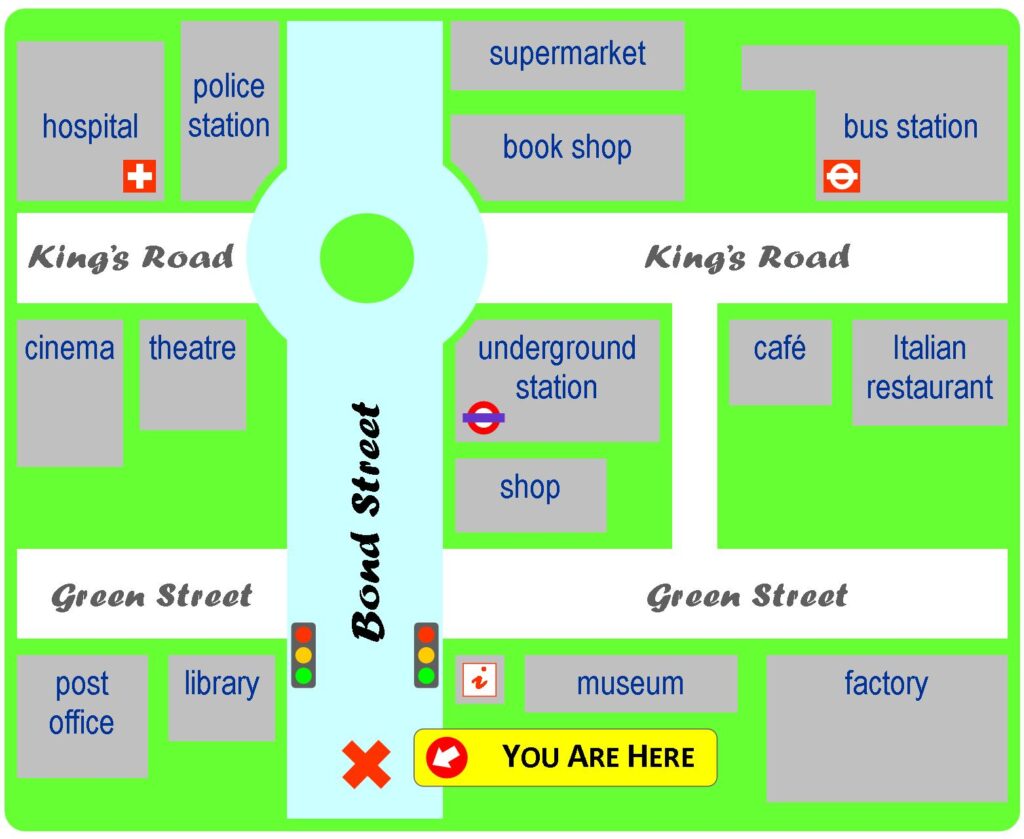
Do the preparation exercise before you listen. Then, look at the map and listen to the directions while you do the other exercises.
Instructions
Do the preparation exercise before you listen. Then do the other exercises to check your understanding.
Preparation
See moreDo this exercise before you listen.
HideCheck your understanding:
See moreDo this exercise while you listen.
ShowCheck your understanding:
See moreDo this exercise while you listen.
Describing people
Listen to the conversation and do the exercises to practise and improve your listening skills.

Instructions
See moreDo the preparation exercise before you listen. Then do the other exercises to check your understanding.
Preparation
See moreDo this exercise before you listen.
Audio
HideCheck your understanding: multiple choice
See moreDo this exercise while you listen.
ShowCheck your understanding:
See moreDo this exercise while you listen.
Download
Band auditions
Listen to the conversation and do the exercises to practise and improve your listening skills.

Instructions
Do the preparation exercise before you listen. Then do the other exercises to check your understanding.
Preparation
See moreHideCheck your understanding: true or false
See moreDo this exercise while you listen.
Check your understanding
See moreDo this exercise while you listen.
Transcript
See moreAdvice for exams
Listen to the teacher giving students advice for exams and do the exercises to practise and improve your listening skills.
Instructions
Do the preparation exercise before you listen. Then do the other exercises to check your understanding.
See morePreparation

Check your understanding: multiple choice
See more
HideCheck your understanding: grouping
See more
Choosing a musical instrument
Have you ever thought about taking up a musical instrument? Here’s the perfect guide for you.
Instructions
Do the preparation exercise first. Then read the text and do the other exercises.
Preparation
See moreChoosing a musical instrument
Reading
See moreChoosing a musical instrument
Many people would like to learn how to play a musical instrument, but they are put off by one big problem: what to play? Here are a few questions to help you decide.
What kind of music do you like?
Many instruments are versatile, but some are more suited to certain types of music. Although there is some classical repertoire for the saxophone, for example, people associate it more with jazz, and it is not a permanent feature of many orchestras. Some instruments may lend themselves better than others to the music you like, so consider this before you start.
Do you want to play with other people?
Think about your long-term future as a musician. If you want to play with other people, what sort of instrument would be most practical? The initial attraction of playing a dazzling solo instrument like trumpet, violin, flute or lead guitar might fade when you realise how many other people are competing with you to get the main part with the same instrument! If you want to play rock music, there will always be a demand for bass players or drummers, and if you fancy being part of an orchestra, the bassoon is a great bet to make sure you are always needed.
Where are you going to practise?
Many people live in flats and practising the drums, for example, will drive your neighbours crazy. Think about where and when you are going to practise, as well as the patience of the people you live with or near. Electric versions of instruments like the piano, drums, guitar and even violin give you the option of playing into the night using headphones, while your housemates sleep in peace. Alternatively, you may need to consider going to a school or a community centre to practise.
How much money can you spend?
This is quite a big factor. A lot of instruments can be purchased in different price ranges, for example, guitars. But this doesn’t alter the fact that many, such as the piano, are always pretty expensive. If you can’t afford your chosen instrument, will you be able to borrow someone else’s or hire one?
Are there any physical limitations?
If you’re small and don’t like lifting heavy objects, you won’t want to carry around a double bass. Apart from that, use your common sense, and don’t let your perceived physical shortcomings put you off. Who says small skinny people can’t play the tuba? It’s true that some wind instruments require a lot of lung power but with the right coaching, everyone can develop the right technique.
Still not sure?
Talk to people you know who already play instruments. They might even let you try theirs. It’s also a good idea to find an experienced music teacher, preferably one who plays a few different instruments, who can give you some advice and push you in the right direction.
If you find an instrument you love and that suits your needs, you’ll find the time spent choosing was well worth it. Good luck with making your choice!
Task 1 Check your understanding
See moreChoosing a musical instrument
Choose the correct option to complete the sentences.
Task 2 Check your understanding
See moreChoosing a musical instrument
Help others, help yourself

Listen to the radio interview with two young volunteers and do the exercises to practise and improve your listening skills.
Instructions
Do the preparation exercise before you listen. Then do the other exercises to check your understanding.
Preparation
See moreHelp others, help yourself
Match the verbs with their collocations.
Task 1 Check your understanding
See moreHelp others, help yourself
Put the activities in the correct groups.
Task 2 Check your understanding
See moreHelp others, help yourself
Read the questions and chose the correct answer.
Free time

Listen to Tyrone calling the staff at his local swimming pool and do the exercises to practise and improve your listening skills.
Instructions
Do the preparation exercise before you listen. Then do the other exercises to check your understanding.
See morePreparation
Do this exercise before you listen.
Task 1 Check your understanding
Do this exercise while you listen.
See moreFree time
Complete the registration form with Tyrone’s information.
Task 2 Check your understanding: true or false
Do this exercise while you listen.
See moreFree time
Are the sentences true or false?
Comentarios recientes