A conference programme

Read the programme for a management conference to practise and improve your reading skills.
Do the preparation task first. Then read the text and do the exercises.
Preparation
See MoreReading Text
See More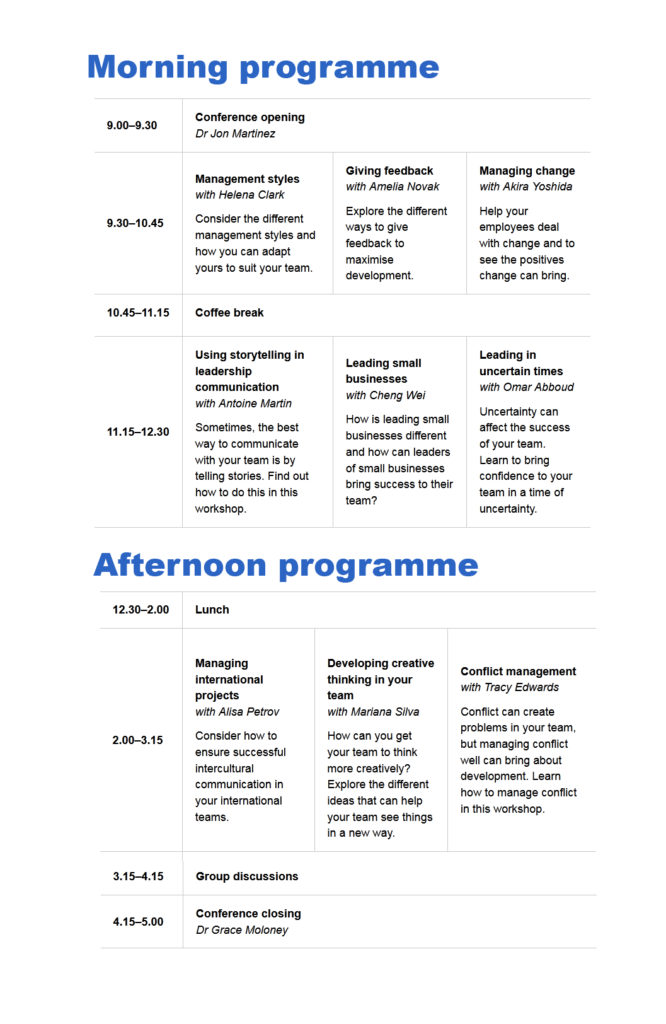
Task 1
See MoreTask 2
See MoreA message to a new friend

Read a direct message on social media to practise and improve your reading skills.
Do the preparation task first. Then read the text and do the exercises.
Preparation
See MoreReading A2: A message to a new friend – preparation
Reading text
See MoreHi Lucia
How are you? It was so nice to meet you last week in Sydney at the sales meeting. How was the rest of your trip? Did you see any kangaroos? I hope you got home to Mexico City OK.
Anyway, I have the documents about the new Berlin offices. We’re going to be open in three months. I moved here from London just last week. They are very nice offices, and the location is perfect. There are lots of restaurants, cafés and banks in the area. There’s also public transport; we are next to an U-Bahn (that is the name for the metro here). Maybe you can come and see them one day? I would love to show you Berlin, especially in the winter. You said you have never seen snow – you will see lots here!
Here’s a photo of you and me at the restaurant in Sydney. That was a very fun night! Remember the singing Englishman? Crazy! Please send me any other photos you have of that night. Good memories.
Please give me your email address and I will send you the documents.
Bye for now
Mikel
Task 1
See MoreReading A2: A message to a new friend – 1
Task 2
See MoreReading A2: A message to a new friend – 2
Prueba lección 5 y 6
EJERCICIO 11
Dictado
EJERCICIO 12
Conversación, conteste las siguientes preguntas en afirmativo
Creating a study group

Listen to the conversation about creating a study group to practise and improve your listening skills.
Do the preparation task first. Then listen to the audio and do the exercises.
Preparation
See MoreTranscript
See MoreAli: Hey, you guys, I’ve been looking for you. I’ve got an idea – a study group. What do you think? Are you interested?
Dina: Yes! I need a study group, in a big way.
Bea: Me too.
Ali: Do you think we have enough people here for a study group? I mean, there are only four of us …
Bea: Sorry. Three of us. Chris can’t do study group. Right, Chris?
Chris: Yeah, there’s no way I can do a study group. I have an assignment and then I’m too busy. But I’ll stay for this first meeting.
Ali: Should we try and get another group together with us for this?
Bea: No, I don’t think so. I think three is fine. Ideal size, really.
Dina: Me too.
Ali: OK, three people then. Four people for the first meeting. What next?
Bea: What about a meeting place? We can’t meet here in the library …
Ali: It’s not too bad, especially if those other people would go away.
Bea: But we can’t exactly ask them to leave, and people might get annoyed with us talking.
Dina: Can I say something here?
Ali: Sure, go ahead.
Dina: There’s a study hall next to the cafeteria. It’s almost always empty. Could we meet there?
Ali: A study hall?! Who knew? Well, it sounds good to me.
Bea: Yeah. I’ve never been there but …
Ali: So, we ought to decide how long for and how often.
Dina: I read somewhere that you should make the meeting at the same time each week. Like a seminar. That way we’d take it more seriously.
Bea: We may as well make it for this time since we’re all here. Is this time OK?
Dina: Works for me.
Ali: Me too.
Chris: Hang on just a minute. I know I’m not going to be in this group, but aren’t we supposed to have a seminar at this time every other week?
Dina: Umm, no.
Bea: Thursday, no?
Ali: No, that’s on Thursday.
Chris: Sorry. Forget I said anything.
Ali: Don’t worry about it.
Bea: So everyone agrees that this time is fine? Every week?
Ali: How long should we make it?
Bea: An hour?
Dina: Could we find a way of making it two hours?
Ali: Two hours seems a bit like … too much. To start with then?
Bea: Ninety minutes? Compromise?
Ali: Is that OK with you, Dina?
Dina: Fine by me.
Ali: OK, so I guess all we have left to decide is exactly what we’ll do when we meet. The final exam is a way off. I guess we could review our notes, or practise learning things by heart.
Dina: I have a list of dos and don’ts actually that I got online. I could be a moderator, and we could use the ideas as a starting point …
Task 1
See MoreListening B2: Creating a study group – 1
Task 2
See MoreListening B2: Creating a study group – 2
Business news

Listen to the business news to practise and improve your listening skills.
Do the preparation task first. Then listen to the audio and do the exercises.
Preparation
See moreTranscript
See moreThe first item in the news today is the recent elections that took place across the country. This was a crucial vote, which may see a dramatic change in how the country develops over the coming years. Overall, a 54.5 per cent voter turnout was registered. This represents an increase of 11 per cent over the previous election and six per cent above the average for the past 50 years. There has also been a slight change in demographics, with an increase in youth turnout in the 18- to 24- and 24- to 29-year-old brackets. Despite this increase, young people are still less likely to vote than older people; 84 per cent of voters in the 70 plus age group came to the polling stations.
Moving on, the global digital powerhouse ONK today posted quarterly results which were above forecast. Back in March, Tim Bolling, CEO, issued a profit warning over fears that there would be losses following the recall of their leading product, the 40d device. In fact, the company posted quarterly revenue of US$14.8 billion which represents an increase of 11 per cent from the same quarter a year ago. They also announced that they had sold 21 million 40d devices over the quarter. The company has provided the information that with this level of revenue, there will be a gross margin of 34 to 35 per cent, ultimately leading to a US$1.20 per share cash dividend awarded to shareholders.
And in our final news item we ask, will we soon be saying goodbye to coins and notes forever? The nationwide trend of using cashless payment options is increasing. There are a number of reasons for this development. A key reason for this is a growing interest in reducing the number of items people need to leave their homes with. As almost everyone carries a smartphone with them, and many people also have smartwatches, the ability to pay for things using one of these two technologies is particularly appealing. More and more retailers are accepting cashless payments and in some cases they’ve stopped accepting cash altogether.
Task 1
See moreChoose the correct option to complete the sentences.
Task 2
A talk about motivation

Listen to the talk about motivation to practise and improve your listening skills.
Do the preparation task first. Then listen to the audio and do the exercises.
Preparation
See More
Transcript
See MoreSo, we think we know how to motivate people, right? Offer them a reward. Do this and you’ll get this. Do this faster, earn more money. Do this better than everyone else, here’s a promotion. We offer incentives when we want people to do things. We do it at work, at school, even at home with our kids. Tidy your room and you can watch TV.
But when social psychologists test whether incentives work, they get surprising results. Sam Glucksberg, from Princeton University, America, set people a problem to solve and told them he was going to time them to see how long they took. Then he put them in two groups. He offered one group a reward for finishing fast. Five dollars for anyone finishing in the top 25 per cent and 20 dollars for the person who finished the fastest of all. To the other group he offered no incentive, but he told them he was going to use their times to calculate an average time.
The first group, the ones with the reward, solved the problem faster, you’d think, right? Well, no, they actually took three and a half minutes longer than the group who just thought they were being timed. Incentive didn’t work. In fact, it made them slower. This experiment has been repeated, with the same results, many times. But in business we still offer bonuses, promotions and rewards to staff.
That’s fine if we want them to do something simple, like chop wood. We’ll pay you more if you chop the wood faster. An incentive works then. But if we want someone to do something complex, something creative, something where they have to think, rewards don’t work. They might even have the opposite result, and make people perform worse. Another study, by Dan Ariely, showed that the bigger the reward, the worse the subjects performed on a complex task. The reward made them focus so hard on the result that they couldn’t think creatively any more.
And this all matters because more and more simple jobs will become automated. We’ll be left with creative, problem-solving jobs that computers will never do. And we need to find a way to motivate people to do those jobs when we’ve proved the traditional incentives don’t work.
So what does work? Giving your workers freedom; freedom to work on the things they want to work on, freedom to choose when, where and how they work. Want to work from home three days a week, get up late and work into the night instead? Fine. Just do the job well. And evidence shows people who choose the way they work get results. Companies that give employees time during the week to work on things that interest them and are not part of their regular job achieve amazing things. Some of the big tech companies are good examples of this, with ping-pong tables and areas to relax in …
Task 1
See More
Task 2
See More
Comentarios recientes