
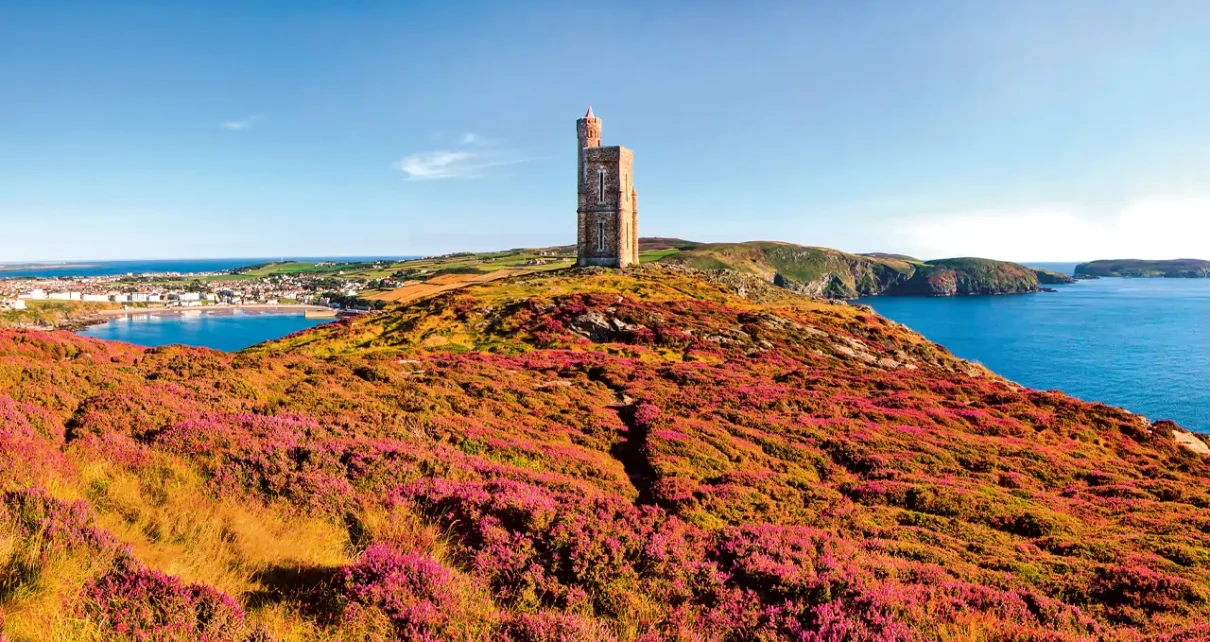
Con una herencia celta y vikinga, restos arqueológicos de enorme valor y una gran belleza natural, la isla de Man goza de un estatus inusual como dependencia de la Corona británica, así como de una legislación fiscal que la hace muy atractiva.
It is not part of the United Kingdom, but its citizens are British. It has its own language, parliament, currency and culture. It even has its own wildlife. It is the Isle of Man, an island situated between Scotland, Wales, England and Ireland. Known as the “gem of the Irish Sea”, this small nation is celebrated for its natural beauty and friendly, easy-going people.
CELTIC ORIGINS
The Isle of Man has a rich heritage. The island’s name —Ellan Vannin, in the Manx language— comes from Manannán, the Celtic god of the sea. The first inhabitants were settlers from Ireland. They converted to Christianity when Celtic missionaries arrived in the 5th century. Hundreds of small chapels called ‘keeils’ were built and burial sites were marked by stone crosses.
VIKING INVASION
The Vikings arrived in AD 798. The island was on the sailing route from Scandinavia to Ireland. They came to plunder, but they eventually settled. The island had fertile land and good harbours. The Norse invaders established a colony, which became a prosperous trading post. For a while, the Norse gods supplanted Christianity. The stone crosses were engraved with images of Viking mythology. Today, they are a great legacy of early Christian faith and Viking settlement.
Viking rule ended in 1265. The Isle of Man was handed over to Alexander III of Scotland. The island alternated between Scottish and English rule until it was given to Sir John Stanley by Henry VIII in 1405. A long period of stability followed. By the 16th century, it had become a smugglers’ paradise. Contraband trade became so common that the British government introduced a special law to suppress it.
MODERN MAN
Today, relations with the United Kingdom are friendly. The island is a self-governing British Crown Dependency, just like the Channel Islands, Jersey and Guernsey. It has its own parliament, government and laws. In fact, it has the oldest continuously running parliament in the world. Known as Tynwald, it was established by the Vikings in AD 979. ‘Tynwald’ means ‘open assembly’ in old Norse.
The UK government, on behalf of the Crown, is responsible for its international relations.
Despite its British connection, the Isle of Man has a distinctive culture. Its language, however, is slowly disappearing. A Gaelic language, Manx was declared dead by Unesco in 2009. The last native speaker was Ned Maddrell, who died in 1974. A new movement is trying to revive it, through schools, music and social media.
PEACEFUL NATURE
All in all, Manx culture is prettylaid-back. A well-known Manx expression is ‘Traa dy Liooar’, which means ‘time enough’. Perhaps the local attitude comes from living in an area of natural beauty. The whole island is a member of the Unesco world network of biosphere reserves.
It is not big, measuring just 33 by 13 miles. A rocky coastline surrounds a rural landscape. In the middle stands Snaefell mountain, the highest point of the island. On a clear day, you can see what the locals call ‘the seven kingdoms’: England, Ireland, Scotland, Wales, the Isle of Man, plus the kingdoms of Heaven and the Sea.
I stand
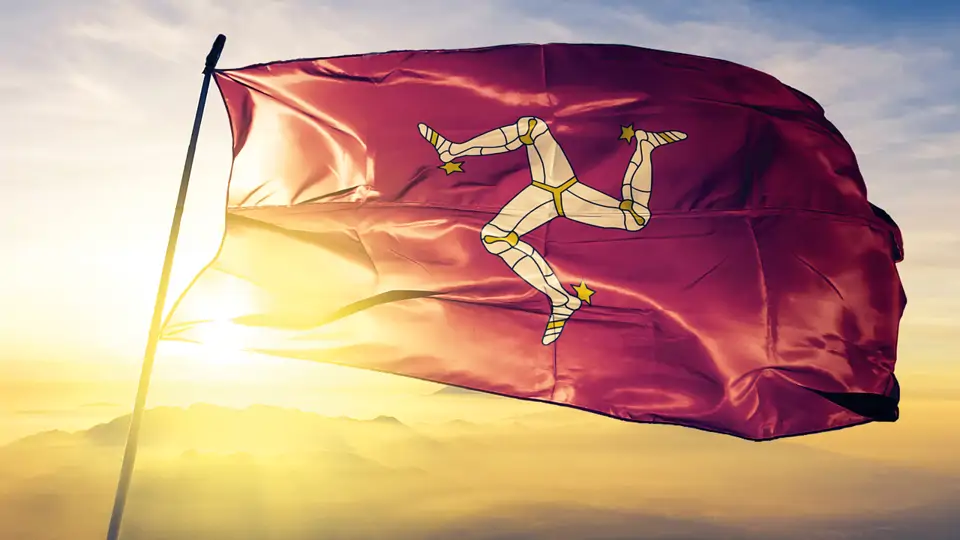
The flag of the Isle of Man is very unusual. Called the Flag of Man, it depicts a triskelion. Derived from the Greek word ‘triskeles’ meaning ‘three legs’, it is an ancient Celtic symbol. The Isle of Man’s triskelion literally has three legs. It shows three armoured legs with golden spurs, on a red background.
Adopted as the official flag in 1932, it is based on the 13th-century Manx coat of arms. The three legs were a symbol of the sun and of power and life. There is much debate about which way the legs should run. Whichever the case, its motto is clear: ‘Quocunque Jeceris Stabit’, which means ‘Whichever way you throw me, I stand’.