
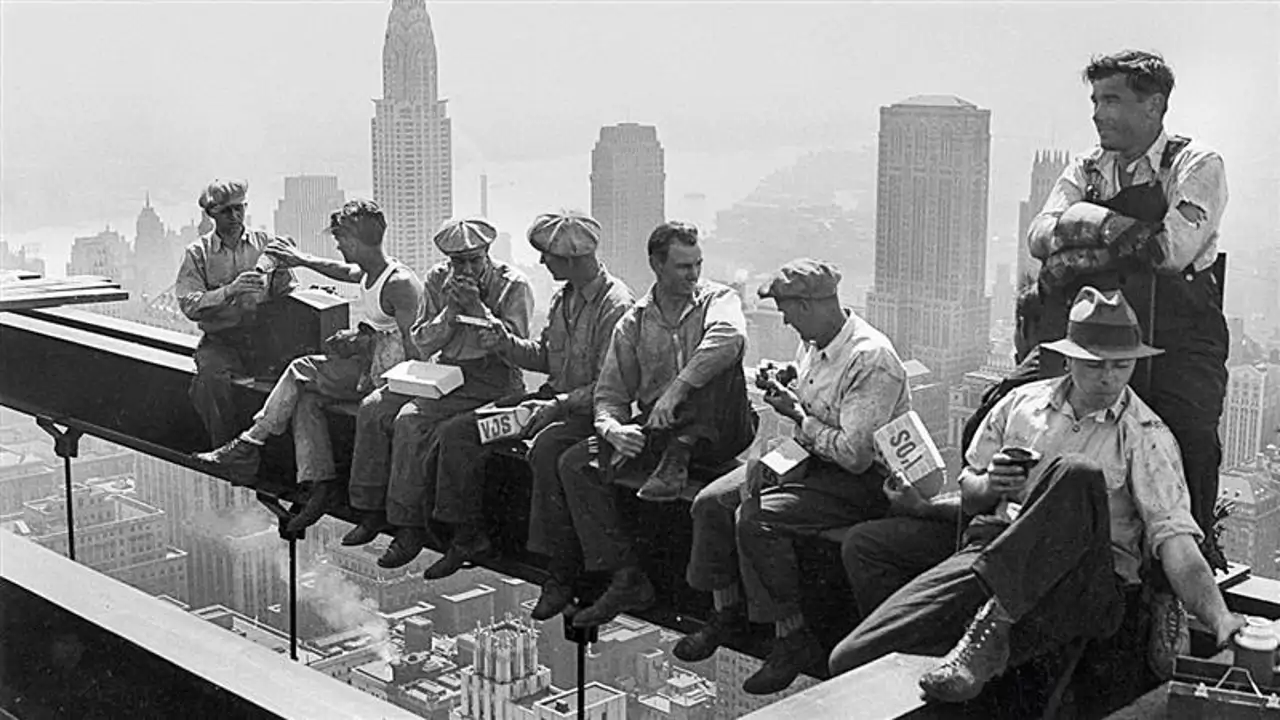
Los rascacielos son un fenómeno moderno que apareció a finales del siglo XIX. Desde entonces, los avances en tecnología y materiales han redibujado el perfil de las grandes capitales mundiales.
Conor Gleeson

What exactly is a skyscraper? Many buildings are tall … but when can you call them ‘skyscrapers’? The generally-accepted rule is a minimum of forty storeys and a height of one hundred and fity metres. The expression ‘skyscraper’ was first used in the 1880s, in the USA, to talk about buildings of more than ten storeys. The Home Insurance Building, in Chicago, completed in 1885, and forty-two metres high, is considered the world’s first skyscraper.
COMPETITIVE SPIRIT
Chicago and New York then spent decades in a battle to construct the highest building. The high price of land obliged constructors to build vertically and not horizontally. New York had the world’s tallest building from 1908 to 1974: the Empire State Building. From the 1930s, however, the concept of skyscrapers started to spread around the world.
CONDITIONS FOR SKYSCRAPERS
Skyscrapers were made possible thanks to industrialisation and the incredible growth of cities. The world now had cheap energy, raw materials such as steel and concrete, and cheap, abundant labour. These tall buildings, however, created specific problems. They have to support incredible weights, resist strong winds and even earthquakes, protect people from fire and transport them to enormous heights. The invention of the modern elevator in 1852 was a pre-condition for skyscrapers.
HOW DO YOU SAY…
Apuntar alto.
To reach for the sky.
Top 5: Reshaping the Skyline
The following skyscrapers are certainly not the tallest, but they are definitely among the most iconic.
1. Lakhta Center
Completed in 2019 in Saint Petersburg, more than three thousand people worked to make the building the tallest in Europe at 462 metres. There is a free observation deck at 357 metres. There are 62 normal lifts and also special firefighter lifts.
2. Empire State Building
The most famous skyscraper in the world, it was built in 1930-31 at a floor a day! Fourteen years later, it was hit in bad fog by a plane. The building has an annual race from the ground to the 86th floor.
3. One World Trade Center
At 541 metres, this is the tallest building not just in New York but in the entire Western Hemisphere! It was built as a commemoration after the 9/11 attacks. People can still visit the last remaining piece of the Twin Towers.
4. Chrysler Building
This iconic New York art-deco masterpiece was described as “hot jazz in stone and steel” by the architect Le Corbusier. Walter Chrysler built it and paid for it so that his sons would have “something to be responsible for.”
5. Shard
The “Shard of Glass”, now an emblematic part of London, is the tallest building in the United Kingdom at 309.7 metres. It has eleven thousand panes of glass. People have abseiled from the building for charity.
Glossary
See more
generally-accepted rule: regla comúnmente aceptada
storeys: plantas
height: altura
insurance: seguros
to spend: dedicar
land: terreno edificable
to spread: expandirse
growth: crecimiento
raw materials: materias primas
steel: acero
concrete: cemento
labour: mano de obra
weights: pesos
earthquakes: terremotos
deck: plataforma
lifts: ascensores
firefighter: bombero
a floor a day: una planta al día
fog: niebla
race: carrera
last remaining piece: el último trozo que queda
in stone and steel: de piedra y acero
to be responsible for: de lo que responsabilizarse
shard: esquirla
panes of glass: placas de cristal
to abseil: descender en rápel